
Reading Cameron's Head: Teeth, Jaws and Reconstruction
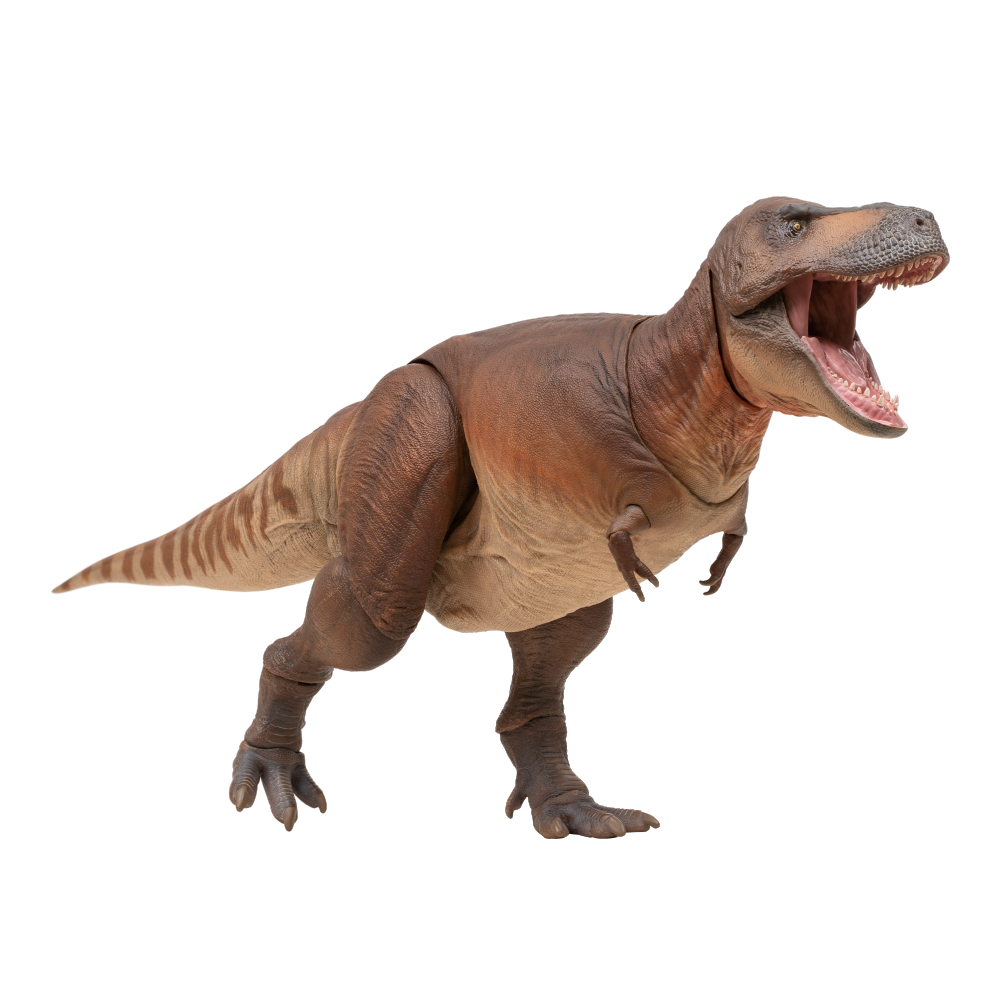
Before you pose Cameron, take a close look at the head. Its broad outline, the jaw and the teeth each reflect a specific choice in PNSO's reconstruction.
PNSO based Cameron on Sue, one of the largest, most complete and best-preserved Tyrannosaurus rex skeletons ever found. Sue was discovered in South Dakota in 1990 and is now on display at the Field Museum in Chicago. Like Sue's skull, Cameron's head is square and sturdy at the back, its snout is broader than in most meat-eating dinosaurs, and its U-shaped lower jaw gives it an enormous mouth.
For all its size, the skull is lighter than it looks. Large openings in the bone saved weight and gave the jaw muscles room to attach. The nasal bones along the top of the snout were fused together, which helped the skull withstand the force of a bite.
Cameron's jaws could open as wide as 63.5 degrees. The largest teeth were as thick as big bananas, with serrated edges for slicing flesh. The visible crown is about 15 centimeters (6 inches) long, but that is only half the tooth; the other half is the root, anchored deep in the jaw. One widely cited study puts the bite force of T. rex at about 34,500 newtons (7,800 pounds). Its teeth were replaced roughly every two years, even when they were not damaged, so they stayed sharp.
Look above the jaws, too. Cameron's eyes were about the size of a tangerine and faced forward, giving it binocular vision for judging the distance to prey. The horn-like bumps above the eyes are called postorbital bosses. The rough ridge along the top of the snout was probably covered in keratin, the same material as our fingernails. Its exact shape is uncertain, but most paleontologists think it formed a low, hardened layer rather than a tall horn.
The mouth deserves a second look, because Cameron has lips. Whether Tyrannosaurus really had them is still debated. Researchers who favor lips point to lizards, whose lips help keep the mouth moist, and to well-preserved fossil teeth that show none of the wear caused by constant exposure. A 2023 study in Science by Thomas Cullen and colleagues also concluded that Tyrannosaurus most likely had lips covering its teeth when the mouth was closed. Other researchers disagree, and the manual that comes with the model shows Cameron both with and without lips. For the model itself, PNSO chose lips.
Try comparing the same head from the side and from the front. Then step back and look at its relationship to the rest of the body. A close-up rewards attention to shape; a whole-model view helps you judge the overall impression.
For a comparison of articulated and Museum Series Cameron, explore our model guide. It separates the two versions and helps you choose which kind of display you want.
Sources: PNSO's official Cameron introduction and the manual included with the articulated model.
Further reading: Cullen, T. M. et al. (2023). Theropod dinosaur facial reconstruction and the importance of soft tissues in paleobiology. Science 379, 1348–1352.
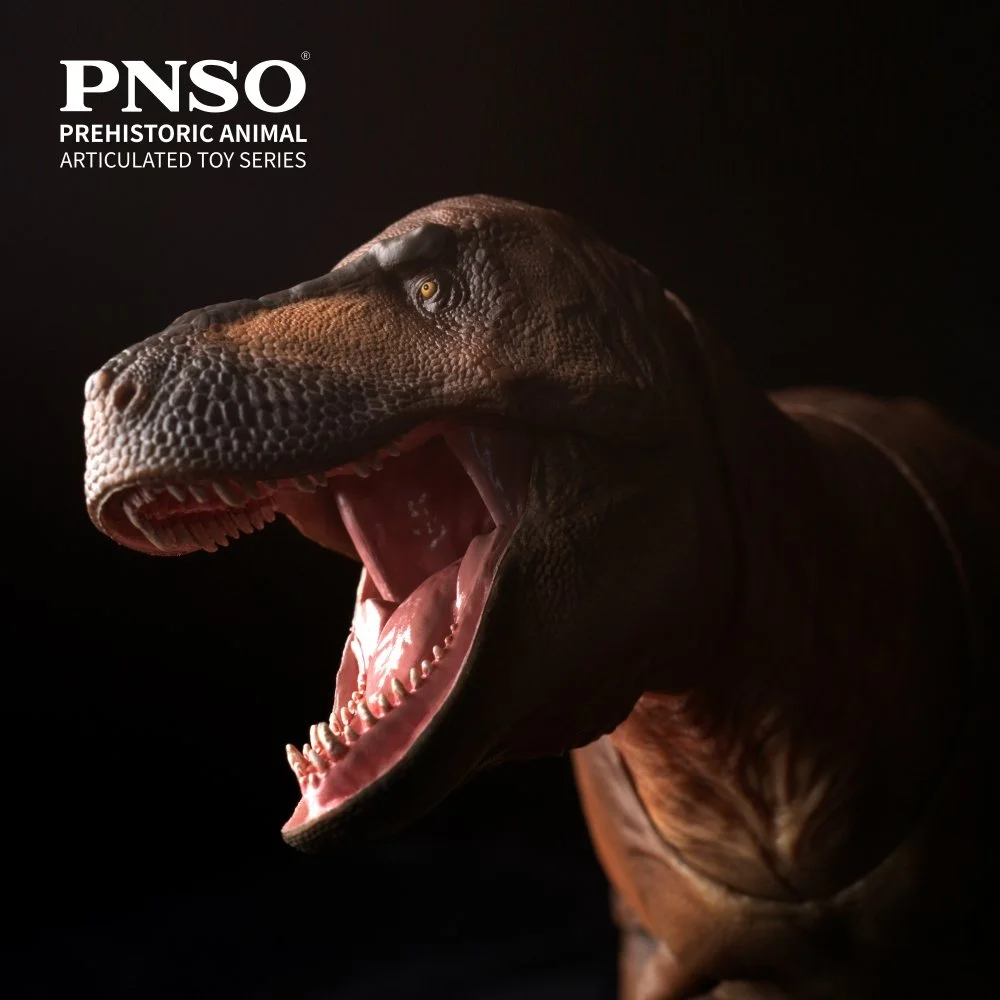
An oblique close-up of articulated Cameron brings the jaw outline and visible teeth into view.
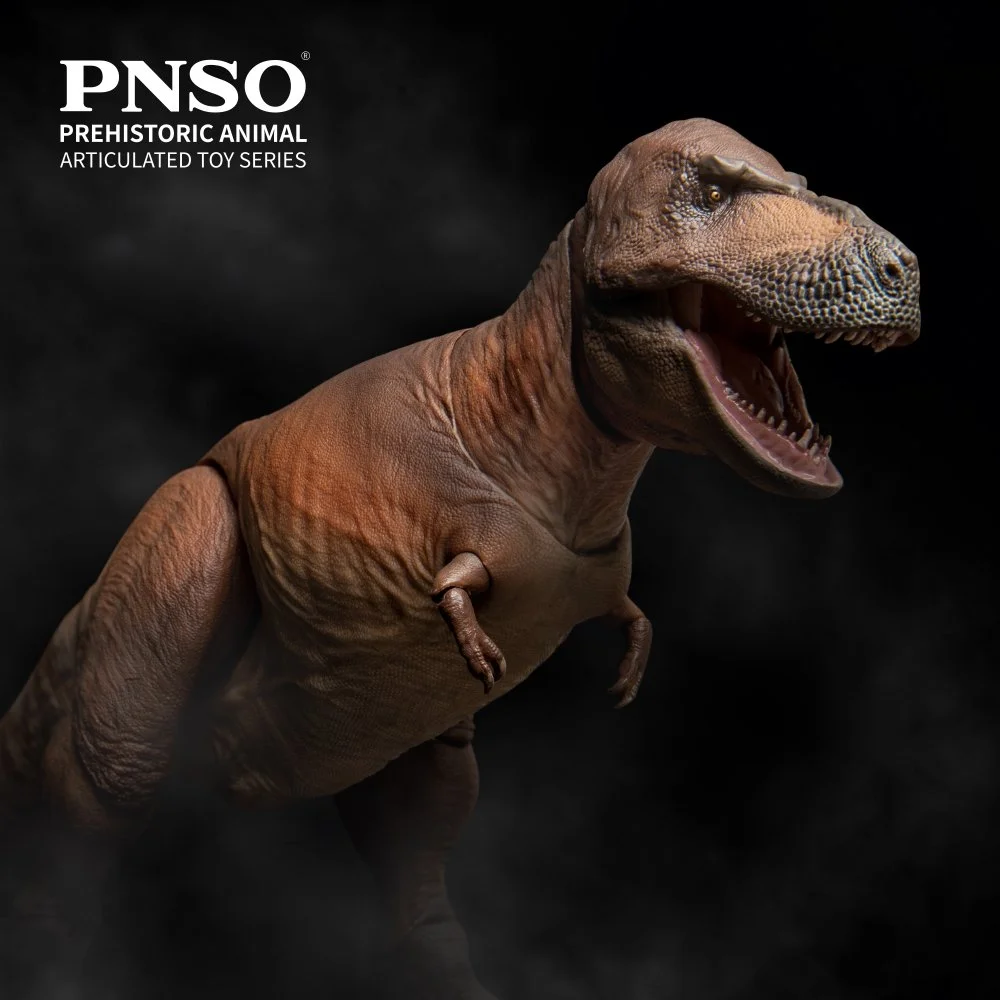
A front three-quarter view shows how the broad head relates to the neck and upper body.